Thursday, July 30, 2009

Forex Market Overview

Introduction

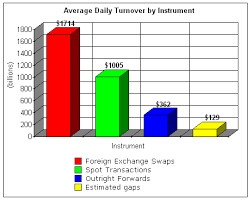
The following facts and figures relate to the foreign exchange market. Much of the information is drawn from the 2007 Triennial Central Bank Survey of Foreign Exchange and Derivatives Market Activity conducted by the Bank for International Settlements (BIS) in April 2007. 54 central banks and monetary authorities participated in the survey, collecting information from approximately 1280 market participants.

Excerpt from the BIS:

"The 2007 survey shows an unprecedented rise in activity in traditional foreign exchange markets compared to 2004. Average daily turnover rose to $3.2 trillion in April 2007, an increase of 71% at current exchange rates and 65% at constant exchange rates...Against the background of low levels of financial market volatility and risk aversion, market participants point to a significant expansion in the activity of investor groups including hedge funds, which was partly facilitated by substantial growth in the use of prime brokerage, and retail investors...A marked increase in the levels of technical trading – most notably algorithmic trading – is also likely to have boosted turnover in the spot market...Transactions between reporting dealers and non-reporting financial institutions, such as hedge funds, mutual funds, pension funds and insurance companies, more than doubled between April 2004 and April 2007 and contributed more than half of the increase in aggregate turnover." - BIS

Structure

  • Decentralised 'interbank' market
  • Main participants: Central Banks, commercial and investment banks, hedge funds, corporations & private speculators
  • The free-floating currency system arose from the collapse of the Bretton Woods agreement in 1971
  • Online trading began in the mid to late 1990's

Friday, July 24, 2009

forex make money to easy way

Whether you’re a stock broker, mortgage broker or loan officer, FOREX trading is an essential part of one’s portfolio. FOREX trading is an extremely lucrative, yet volatile and risky market. The facts state that 95% of FOREX traders lose money in there first year of trading. Why then must FOREX be considered a part of one’s portfolio? Simply because trading FOREX has the potential to make anyone who is willing to learn the FOREX market thousands of dollars per month.

It wasn’t until recently that average everyday people were able to trade in the FOREX market. Now it’s easy to obtain a mini account, fund it with $300 and off you go. However, if trading the FOREX market were this easy, then everybody would become millionaires and this just isn’t the case.

FOREX trading requires consistent analysis of the market. There are two ways that FOREX traders assess the market. The first is what is known as fundamentals. Fundamentals rely on news events such as, CPI, retail sales and home sales. FOREX traders will make a projection for upcoming data and place their trade based on their speculations of upcoming news events.

Thursday, July 23, 2009

golden forex offical

Full Transparent Inter
Full Transparent Inter Bank Quotes
2 to 3 pip Spreads on all Majors

Trading and Support Hotline Through
Phone, MSN, Yahoo, Skype and Fax

Standard, Mini, and Micro Lots
Full Hedging Capacity And
Real Trailing Stops
On The Spot News Service and
Market Reports
Trade on The Same Platform
Forex Majors & Crosses, Gold,
Bank Quotes


2 to 3 pip Spreads on all Majors


Trading and Support Hotline Through
Phone, MSN, Yahoo, Skype and Fax


Standard, Mini, and Micro Lots


Full Hedging Capacity And
Real Trailing Stops


On The Spot News Service and
Market Reports


Trade on The Same Platform


Forex Majors & Crosses, Gold,Unique Trading Advantages: - Full "Hands Off" Trading Possibility Allowing our Traders to Take Over The Actual Trading When You Choose.
- Free EA Trading / Hosting: We Will Safely Host Our Customers EA's On Our Servers For Free Providing Them with a 24/7 Fast and Reliable Connection to Our Trading Servers.
- Fully Managed Accounts By Golden Forex Inc. Trading Team.
- Fully Managed Accounts by High Performance Proven Traders.
- Free Back Test of all Customers EA's Logic On Dedicated Software With HGFD Tick Data


Friday, July 3, 2009

forex Educational Guide For Beginners

An Educational Guide For Beginners To The Forex Market

Are you new in the Forex market? This market may sound really complicated and scary to trade in but its not. Just like in any other kind of trade, you make money when you buy low and sell high. Forex trading is simply trading currencies in the Forex market.
Forex is the largest financial market in the world. It generates trillions of dollars of currency exchanges everyday and it operates 24 hours a day and seven days a week therefore, also making it the most liquid market in the world.
In the world of Forex, trading is very unique compared to other financial markets like stocks. Since the Forex market operates 24 hours a day worldwide, which starts in Sydney and ends in New York, trading is not centralized in one location. You can trade in Forex whenever you want regardless of the local time.
In the past, Forex trading was only offered to large financial institutions like banks, large companies, multi-national corporations and large currency dealers. This was due primarily to the large and extremely strict financial requirements the Forex market imposed. This means that individual traders and small businesses are not able to participate in this liquid market.
However, in the late 90s, Forex was made available to individual traders and small businesses. This is due to the advances in the communications technology. High speed internet made it possible for people to enter the Forex market and have become one of the best make money at home businesses.
Forex trading is getting more and more popular each day. Who wouldnt want to trade in the largest and the most liquid financial market in the world? Trading in Forex will certainly give you the opportunity to earn a lot of money. However, trading in this ever liquid market also has its risk. It is a fact that many people who traded in Forex lost a substantial amount of money and some of these people are seasoned traders.
This is why it is very important for you, as a beginner trader in the Forex market, to have the proper knowledge and education on how to trade in the Forex market. Firstly, there are hundreds or even thousands of available websites on the internet that offer Forex education. Some of these websites offer dummy Forex trading where you can practice trading in the Forex market using play money.
These programs will really take you closer to actually trading in Forex. Many experts say that youll never really understand how Forex really works until you have traded in the market. So, if you want to learn how to trade Forex, you may want to sign up for a dummy account that numerous Forex trading websites offer.
To get started in trading Forex, all you need is a computer with a high speed internet connection, a funded Forex account, and a trading system. These three simple things are enough to get you started in Forex trading.
In order for you to minimize the risk of losing money, you need to have some basic knowledge in charting before you start trading. In most Forex trading systems, Forex charts are there to assist you with your trades. Forex charts are a visual representation of the exchange rates of currencies. This is where you will mostly base your decisions to buy and sell currencies. You have to learn how to read the different Forex charts in order for you to successfully trade in the Forex market.
Each Forex chart is different although they represent the same fluctuations. For example, in the daily Forex chart, you can evaluate market trends in the past 24 hours to help you make decisions on the next 24 hours of trading. In the hourly chart, you can use this chart to spot trends within the day. And, in the 15 minute chart, where it can help you recent currency fluctuations in a 15 minute interval to help you decide on which currency to buy and sell. Sometimes, there are 5 minute chart available to better help you get closer to the action.
These are the basics on how to trade in the Forex market. Always remember that aside from the promising earning potential that you can have in the Forex market, there are also underlying risks that you have to consider. It is therefore wise to trade in this market with a proper investment plan and strategy. If you are just starting out to trade in Forex, consider opening a dummy account to help you practice trading Forex without risking money.
Thursday, June 4, 2009

London Session

EUR/USD has pushed higher late in the London morning, taking out the 1.4200 level. While price action has picked up in the approach to the US open, earlier in the day consolidation and profit-taking had been a more dominant theme in many cross rates and assets classes. European stocks traded lower through most of the morning, cable had continued to shy away from the GBP/USD1.6400 level and the EUR, AUD and NZD had spent most of the morning lower vs the USD. The approach of key central bank meetings and the US payrolls data later in the week had injected a cautious tone into the market.

The rise in the Eurozone unemployment rate to 9.2% in April from 8.9% in March has focused attention on the ongoing economic difficulties facing the region. Overnight, the RBA surprised the market by stating that scope remains for some further easing of monetary policy. Risk is that the ECB could also maintain a dovish tone this week particularly given last week's soft inflation data and this had kept EUR buyers sidelined through most of the London morning.

The EUR's gains vs the USD have now dragged cable through the USD1.6400, a level which had offered resistance through most of the session. Good news for the UK came this morning in the form of a rise in mortgage approvals to 43K in April from 39K in March and a moderate rise in lending on dwellings to GBP1.0 bln. These data signal a tentative improvement in housing demand suggesting the massive softening in monetary policy is beginning to impact. However, it is likely that the BoE will retain its dovish stance at this week's MPC meeting and this may inject a cautious tone into the pound later this week.

USD/JPY has been the biggest mover of the session so far with the USD falling back towards the middle of its range vs the JPY after yesterday's rise. This afternoon, US pending home sales and ABC consumer confidence data will be watched.

New York Session

The commodity complex came off the boil in the NY session and this led to a revival in the US dollar. The weekly oil inventory data showed a massive 2.9 million barrel build in the latest week (market was looking for a -1.5 million draw) and this helped push the oil imbalance back in the favor of supply for the first time in three weeks. Oil briefly tried below $65/bbl before recovering, but the damage was done.

The correlations witnessed over the last month or so were in full force and the commodity currencies bore the brunt of the weakness in crude. USD/CAD confirmed the hourly double-bottom by 1.0790 and squeezed through the 1.0970 neckline. Look for potential to 1.1150 before this is over. AUD/USD saw a similarly impressive decline of about -150 pips in the session. The pair found support at the 200-hour SMA by 0.7940 and was trying to sneak back above 0.8000 ahead of the close.

US dollar strength extended well beyond the commodity currencies. Cable saw an impressive -200 pip drop towards 1.6310/20 and was down about -400 pips on the day at one point. Below 1.6240 opens up potential for further weakness. EUR/USD shed a more modest -50 pips into the 1.4150/60 area. The 1.4100 level remains like a rock and contained the weakness once again. The immediate risk is for a squeeze higher towards 1.4200/50 ahead of tomorrow's ECB meeting. This, however, would set up a potential head-and-shoulders hourly consolidation. If this comes to fruition, then the ensuing 1.41 break could be ''lights out''.

The big story in stocks was that the S&P managed to stay above the 200-day SMA (923.30) today after an earnest attempt on the market's part to take the level out. The index squeezed higher at the end of the day but closed -1.4% in negative terrain nonetheless. The weakness here left the yen crosses heavy with EUR/JPY, for example, dipping -60 pips towards the 135.80/90 zone.

Upcoming Economic Data Releases (Asia Session) prior expected

6/3 23:50 GMT JN Capital Spending 1Q -17.30% -27.10%

6/3 23:50 GMT JN Capital Spending excl Sftwre 1Q -18.10% - -

6/4 1:30 GMT AU Trade Balance APR 2498M 1700M

6/4 2:30 GMT AU RBA Governor Stevens Speech in Townsville

6/4 3:00 GMT NZ ANZ Commodity Price MAY 2.50% - -

6/4 3:00 GMT NZ Commodity Price Index for May

Asia Session


The US Dollar struggled to hold onto earlier overnight gains that were made after some poor data and lower equities poured cold water on the risk trade. The oversold Greenback was given a boost in New York trading as optimism waned with ADP employment data showing over 500,000 jobs lost for May. The EUR/USD dropped from its lofty heights of 1.4338 to hit bottom just under 1.4110 prior to the Asia morning open. The pair entered Asia close to 1.4160 and after a high of 1.4192 and a subsequent low of 1.4136, the pair graciously exited the session right where it began. The trading this session was relatively calm ahead of the slew of central bank decisions on deck for tomorrow from the European Central Bank, Bank of England and the Bank of Canada. Although all central banks are expected the keep rates unchanged, with ECB at 1.00%, BOE at 0.50% and finally the BOC at 0.25%, traders will nonetheless be on the lookout for any signals for future moves from the banks.

The Yen lost favor in Asia, dropping against both the Dollar as well as the Euro. USD/JPY began the Asian trade day near 96.00 and broke above 96.35 before settling near 96.15 prior to the London open. EUR/JPY opened near 135.90 and after a 135.57 low and a high of 136.63 closed the session 40 pips of that aforementioned high. South of Japan, both the Aussie and Kiwi dollars tried to bounce back from yesterday's massive losses, the AUD/USD to the tune of almost 2%, but looked to stay unchanged for the trade day. RBA Governor Glenn Stevens set the stage in a speech where he stated that the possibility for further easing was a strong possibility.

Upcoming Economic Data Releases (London Session) prior expected

6/4/2009

6:45

FR

ILO Unemployment Rate

1Q

8.20%

8.60%

6/4/2009

6:45

FR

ILO Mainland Unemployment Rate

1Q

7.80%

8.00%

6/4/2009

6:45

FR

Mainland Unemp. Change (000s)

1Q

187K

- -

6/4/2009

9:00

EC

Euro-Zone Retail Sales (MoM)

APR

-0.60%

0.20%

6/4/2009

9:00

EC

Euro-Zone Retail Sales (YoY)

APR

-4.20%

-2.80%

6/4/2009


UK

New Car Registrations (YoY)

MAY

-24.00%

- -

6/4/2009

11:00

UK

BOE ANNOUNCES RATES

4-Jun

0.50%

0.50%

6/4/2009

11:45

EC

ECB Announces Interest Rates

4-Jun

1.00%

1.00%

Forex vs. Stocks

Advantage Forex Market Stock Market


Trade Around the Clock

The forex market is a near-seamless 24-hour market. Subject to available liquidity, FXCM offers trading from Sunday, starting after 5:15 PM EST, until Friday, 4PM, EST (FXCM Client Service is available 24/7). With the ability to trade around the clock, currency traders have the advantage of customizing their own trading schedule; they can usually get in or out of the market at any time without waiting for an opening bell or encountering a market gap. While trading stocks after usual market hours is possible, very often that possibility is negated by a lack of order flow or a drastic widening of the bid-ask spread.

Pay No Commissions*

In the forex market costs are confined to the bid-ask spread. FXCM charges no commission or additional transaction fees, and its customers trade on spreads provided to FXCM by some of the world's largest banks via the FX Trading Station. In the stock market, “no-fee” programs are frequently offered only with provisos mandating minimum account balances or minimum trades per month.

No Uptick Rule

Unlike the equity market, there is no restriction on short selling in the forex currency market, no matter which way the market is moving. Since currency trading involves buying one currency and selling another, a trader has the same ability to trade in a rising market as in a falling one.

Forex Market Information Easily Accessible

Information about stocks is abundant, but so are the stocks. Finding a trade opportunity in the equities markets may mean sifting through data on thousands of stocks, while the forex trader has only six major currencies to research. Additionally, the vital information that moves equity markets, such as revenues and profits, is proprietary and private. In contrast, virtually all of the news that bears on the forex market is in publicly disseminated reports from governments or research institutions, and released to everybody at the same time.

We feel that the knowledge you've gained in analyzing stocks can easily be transferred to the forex market. Many of the economic indicators familiar to equity traders, such as payroll data and interest rates, affect the currency markets. And many technical traders have found the forex market to be particularly attractive, since currencies respond well to many of the common technical indicators, such as MACD, RSI, and Candlestick charting.


High Risk Investment

Trading foreign exchange on margin carries a high level of risk, and may not be suitable for all investors. The high degree of leverage can work against you as well as for you. Before deciding to trade foreign exchange you should carefully consider your investment objectives, level of experience, and risk appetite. The possibility exists that you could sustain a loss of some or all of your initial investment and therefore you should not invest money that you cannot afford to lose. You should be aware of all the risks associated with foreign exchange trading, and seek advice from an independent financial advisor if you have any doubts.